Filtration is one of the most universal and frequently repeated steps in laboratory workflows, yet it is also one of the most common sources of delay. When samples contain a broad mix of particle sizes or require precise separation into defined fractions, filtration quickly becomes a bottleneck. Traditional single-mesh strainers are designed for straightforward tasks, but they struggle when workflows demand more than just one level of filtration. Researchers often find themselves repeating steps, transferring samples between multiple strainers, or dealing with clogged meshes—issues that add time, increase contamination risks, and complicate data consistency.
This is where stackable strainers transform the workflow. Instead of treating filtration as a series of disconnected steps, stackable systems allow the entire process to happen in a structured, layered manner. Among the available options, the pluriStrainer Maxi stands out as one of the most efficient and versatile tools for multi-stage filtration.
Engineered to accommodate large sample volumes and adaptable to diverse laboratory needs, the pluriStrainer Maxi performs exceptionally well in applications such as environmental water analysis, microplastic research, agricultural testing, and complex biological fractionation. Its ability to integrate multiple mesh sizes in a vertical stack creates a smooth, uninterrupted filtration cascade. This eliminates unnecessary transfers, reduces clogging, and ensures consistent results across repeated experiments.
In this article, we explore the unique advantages of stackable strainers, how the pluriStrainer Maxi enhances multi-stage filtration, and why it has become a practical upgrade for laboratories aiming to improve efficiency, accuracy, and overall workflow control.
Why Multi-Stage Filtration Matters in Modern Laboratory Workflows
Many laboratory samples are far more complex than they appear. Whether dealing with soil extracts, sediment-rich river water, wastewater effluent, agricultural material, or biological samples containing mixed cell clusters, the variation in particle size can be extreme. Relying on a single mesh size in these situations often produces poor outcomes. Large debris may clog the filter, smaller particles may slip through when they were intended for capture, and inconsistent flow can slow down the entire process. These issues not only disrupt workflow efficiency but also impact the accuracy and reproducibility of downstream analysis.
This is why multi-stage filtration has become a critical part of modern laboratory workflows. By passing samples through a sequence of decreasing mesh sizes, researchers can progressively remove large particulates, preserve mid-range and fine particles for targeted study, and minimize clogging. This stepwise approach improves clarity, allows better control over particle fractions, and supports consistent results across repeated experiments.
A stackable filtration system streamlines this process by removing the need for repeated transfers between tubes or strainers. Instead, each mesh sits directly above the next, allowing the sample to move through the entire sequence in one smooth flow. This reduces handling, lowers the risk of contamination, and saves valuable time.
The pluriStrainer Maxi brings these advantages together in a practical, easy-to-use format, making multi-stage filtration accessible for both small laboratories and high-throughput industrial workflows.
Introducing the pluriStrainer Maxi: Built for Large and Complex Samples
The pluriStrainer Maxi is engineered specifically for laboratories that work with high-volume or high-complexity samples. As a bottle-top sieving system, it accommodates volumes from 100 mL up to more than 10 liters—far beyond the capacity of standard tube-based strainers. This makes it particularly valuable in workflows where samples cannot be reduced or where repeated filtering through small devices would slow down the entire process. With 13 available mesh sizes (5, 10, 20, 40, 70, 100, 200, 300, 400, 500, 1000, 1500, and 2000 µm), the pluriStrainer Maxi supports everything from coarse debris removal to fine particle separation.
Because of its broad mesh range, the Maxi adapts easily to a variety of applications, including environmental water testing, microplastic isolation, agricultural runoff analysis, and filtration of plant, soil, or tissue-derived suspensions. It is equally effective for pre-filtration steps before chemical assays, biological enrichment workflows, or downstream analytical procedures where a clean fraction is essential.
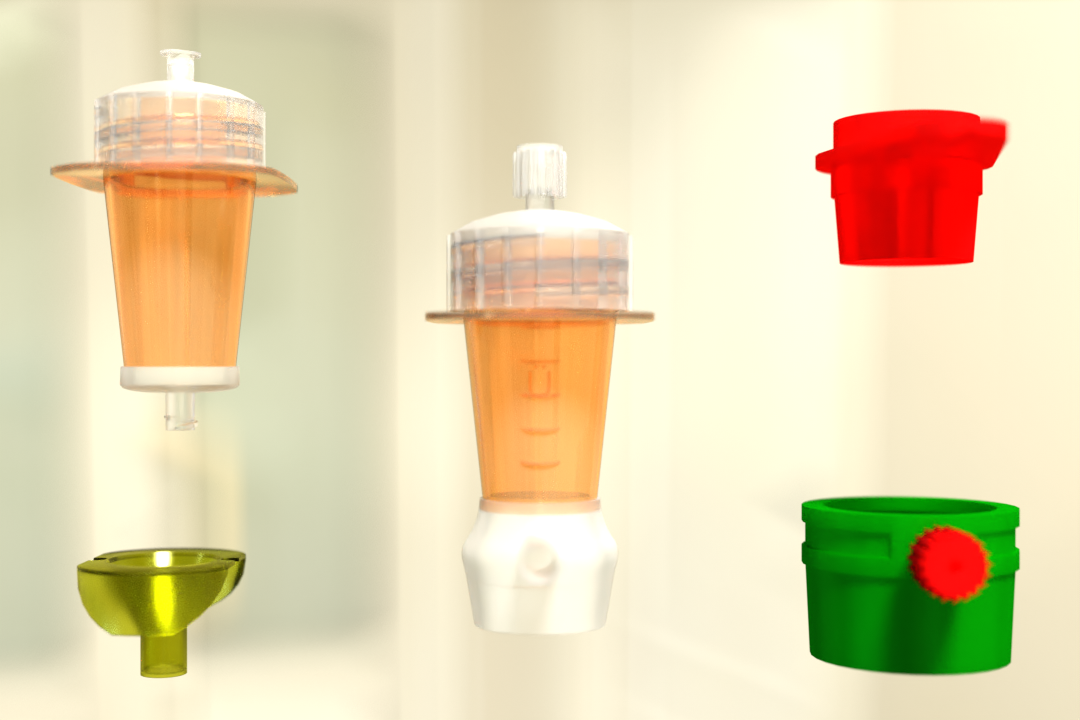
Several design elements support these capabilities: stackability for multi-stage filtration, a port for low-pressure assistance, compatibility with funnels for large sample loads, and adaptors for GL45, GL32, and GL80 bottles. Together, these features make the pluriStrainer Maxi an efficient and reliable solution for complex filtration tasks.
The Advantages of Stackable Strainers: Why pluriStrainer Maxi Excels in Multi-Stage Filtration
Below are the core benefits of using stackable strainers, followed by how the pluriStrainer Maxi applies each of these principles to real-world laboratory workflows.
1. True Multi-Stage Filtration in One Setup
Traditional filtration often requires moving a sample between several containers, each with a different mesh. This increases the risk of error, spillage, and contamination.
With the pluriStrainer Maxi, researchers can stack multiple devices vertically. The sample flows naturally from the largest mesh at the top to the smallest mesh at the bottom, creating a filter cascade that separates particles by size in one continuous run.
Benefits:
- No intermediate transfers
- Greatly reduced contamination risk
- Consistent alignment of mesh levels
- Faster workflow completion
The pluriStrainer Maxi system ensures each fraction is separated cleanly, preserving both large debris and small particles depending on analytical goals.
2. Reduced Clogging and Faster Filtration
One of the biggest problems with single-mesh strainers is quick clogging, especially when the mesh is too fine for the initial sample load. Stackable strainers avoid this issue by distributing the workload across multiple strainers.
With the pluriStrainer Maxi:
- Large debris is removed before reaching finer meshes
- High-flow channels prevent back-pressure buildup
- Clogging is minimized even with dense or particulate-rich samples
This design results in dramatically faster filtration, particularly for environmental and agricultural samples containing leaves, soil fragments, sediment, or organic matter.
3. Greater Precision with Size-Based Fractionation
Many research studies depend on knowing exactly what size range particles fall into. This is especially true in microplastic research, environmental monitoring, and biological cluster analysis.
Stacking pluriStrainer Maxi devices allows researchers to:
- Separate different size fractions with high precision
- Recover targeted fractions for further analysis
- Maintain reproducible filtration profiles across sample batches
Because each mesh size is color-coded, users can quickly identify and assemble the cascade without confusion.
4. Compatibility with High Sample Volumes
Most Lab Cell Strainer systems were not designed for more than 50 mL. The pluriStrainer Maxi fills this gap by allowing filtration of hundreds of milliliters to over 10 liters in one setup.
This is ideal for:
- Environmental sampling projects
- Field studies with large water volumes
- Industrial wastewater quality monitoring
- Agricultural testing laboratories
Stackability ensures that even large volumes can be processed without manual intervention between filtration steps.
5. Funnel Integration for Extended Volume Capacity
Large volumes require more than speed—they require stability. The pluriStrainer Maxi can be combined with a funnel that increases the loading capacity without risking overflow.
This is particularly useful when:
- Sample volumes exceed 2–3 liters
- Suspensions contain foam or organic residues
- Pouring accuracy is difficult in field conditions
The funnel ensures that sample flow remains steady, making multi-stage filtration safer and more controlled.
6. Low-Pressure Filtration for Challenging Samples
Some samples—like microplastic suspensions, viscous agricultural extracts, or plant homogenates—need gentle pressure to move through the mesh.
The pluriStrainer Maxi includes a port for connecting a low-pressure system, allowing:
- Faster filtration
- Reduced clogging
- Less manual shaking or stirring
- Consistent flow even with fine meshes
This makes the pluriStrainer Maxi suitable for automated and semi-automated workflows.
7. Automated Refilling for Continuous Filtration
Multi-stage filtration is often slowed down by the need to manually refill strainers. The pluriStrainer Maxi solves this using a specialized lid with a tubing port, enabling samples to be drawn directly into the system.
Researchers can:
- Connect tubing from a sample reservoir
- Allow continuous inflow without manual pouring
- Maintain steady filtration rates
This is particularly helpful for large-volume environmental projects and flow-through systems.
8. Improved Reproducibility Across Experiments
In any multi-stage filtration workflow, consistency is key. Stackable strainers allow researchers to create identical mesh cascades across multiple experiments.
The pluriStrainer Maxi enhances reproducibility through:
- Standardized dimensions
- Color-coded mesh sizes
- Secure stackable edges
- Stable flow dynamics
This reduces variability and supports high-quality data generation in both research and industrial testing environments.
Workflow Example: Multi-Stage Microplastic Filtration Using pluriStrainer Maxi
Microplastic research frequently requires filtering water samples through several mesh sizes to categorize particle distribution. A common cascade might include:
- 1000 µm – remove macroplastics
- 500 µm – isolate large microplastics
- 100 µm – collect mid-size fragments
- 40 µm – retain smaller particles
- 20 µm – capture fine microplastics
Using traditional strainers, this requires transferring the sample five times.
Using the pluriStrainer Maxi:
- Stack all desired mesh sizes
- Add sample into the top funnel
- Let the cascade do the work
Each fraction is collected cleanly and efficiently.
Workflow Example: Agricultural and Soil Suspension Testing
Plant extracts and soil suspensions contain complex mixtures of organic and inorganic material. Stackable pluriStrainer Maxi devices allow researchers to break these components down into useful fractions for enzymatic studies, microbial analysis, or chemical testing.
Typical cascade:
- 2000 µm → 500 µm → 100 µm → 20 µm
This approach quickly produces:
- Clean filtrates for chemical assays
- Coarse fractions for plant debris analysis
- Microbial-enriched samples for culture
The system supports both manual and low-pressure flow depending on sample characteristics.
Workflow Example: Tissue Cluster Fractionation
Biological workflows often require separating tissue clusters or spheroids into size-specific groups. Multi-stage filtration using pluriStrainer Maxi allows researchers to:
- Collect large clusters from dissociation mixtures
- Separate organoids by developmental stage
- Remove debris without damaging viable structures
The gentle filtration enhances downstream imaging, sequencing, or culture workflows.
Practical Benefits for Daily Laboratory Use
Simplifies workflows
Stackable design removes the need for pouring samples from one strainer to another. Instead, materials pass through multiple mesh sizes in a single setup, reducing manual steps and workflow interruptions. This streamlined process helps researchers maintain consistency while improving overall efficiency during routine or high-throughput filtration tasks.
Saves time
Filtration moves significantly faster when using the pluriStrainer Maxi, especially when paired with its low-pressure support port. Researchers no longer wait for slow gravity flow through a single clogged mesh. Instead, samples progress smoothly through the cascade, reducing total processing time and supporting rapid turnaround for large or complex sample loads.
Reduces contamination risk
Because the system works as a closed, vertically aligned cascade, samples are exposed to open air fewer times. This reduces opportunities for airborne particles, microbial contaminants, or accidental contact. Minimizing handling steps also helps maintain the integrity of environmental, biological, or industrial samples where purity is essential.
Supports large sample volumes
The pluriStrainer Maxi can process hundreds of milliliters to more than 10 liters in one setup, making it ideal for environmental monitoring, wastewater testing, agricultural studies, and microplastic research. Its funnel compatibility and high-flow channel system help laboratories manage large volumes without clogging or workflow delays.
Compatible with standard lab bottles
With built-in GL45 threading and optional adaptors for GL32 and GL80 bottles, the pluriStrainer Maxi fits easily into existing laboratory equipment setups. Researchers can switch between bottle sizes without changing filtration tools, improving flexibility and reducing the need for specialized containers.
Easy to assemble and clean
Color-coded mesh sizes and intuitive components make setup quick, reducing training time for new users. The pluriStrainer Maxi’s simple assembly also supports easy rinsing and cleaning when reusable conditions allow. This practical design supports smooth integration into routine workflows without additional complexity.
Final Thoughts
Stackable filtration has become an essential part of modern laboratory workflows, especially as research demands grow more complex and sample diversity increases. Tools that offer structured, multi-stage separation provide clearer results, smoother workflows, and stronger reproducibility. The pluriStrainer Maxi delivers all these advantages in a format that is practical for both small labs and large-scale processing environments. Its ability to handle high volumes, pair with low-pressure systems, and integrate directly with standard bottle formats makes it far more versatile than traditional strainers.
The stackable design is particularly impactful. By allowing several mesh sizes to be aligned in one vertical system, the pluriStrainer Maxi removes the need for repeated transfers—reducing contamination risks, saving time, and keeping each step of the filtration process consistent from start to finish. This structured approach benefits applications ranging from water quality assessments to microplastic fractionation, cell cluster separation, and agricultural sample processing.
For laboratories seeking to improve throughput, reduce workflow errors, and carry out precise particle separation, the pluriStrainer Maxi represents a meaningful upgrade. It transforms multi-stage filtration from a slow, hands-on task into a streamlined, controlled process—offering reliability, flexibility, and efficiency in every use.
 English
 French
 German
 Spanish
 Belgium
 Italian
 Brazil
 Chinese Mandarin