High-throughput screening (HTS) has become a core tool in modern research and drug development. Whether used for compound screening, immune profiling, toxicity testing, or functional assays, HTS workflows depend on the ability to process large numbers of samples quickly and consistently. At the center of these workflows lies cell preparation. If cell isolation is slow, inconsistent, or damaging to cell function, the entire screening process suffers.
Traditional cell isolation methods were not designed with HTS in mind. Many rely on multiple centrifugation steps, repeated washes, column- or magnet-based separation, and extensive manual handling. While these approaches can work for small-scale experiments, they introduce bottlenecks when scaled to dozens or hundreds of samples. Each added step increases processing time, operator variability, and the risk of activating or damaging sensitive cells, factors that directly affect screening accuracy and reproducibility.
HTS workflows demand something different: fast and predictable isolation, minimal hands-on time, and cells that remain viable and functionally intact. The ideal system must also work directly with common sample types such as whole blood, buffy coat, or cord blood, without requiring special equipment or complex training.
This is where pluriSpin fits naturally into HTS environments. By combining negative cell isolation with standard density gradient centrifugation, pluriSpin simplifies cell preparation while preserving cell integrity. It removes unnecessary handling steps and delivers untouched, functional cells that are ready for downstream screening applications, making it a strong match for high-throughput demands.
Why Traditional Cell Isolation Struggles in High-Throughput Screening
High-throughput screening workflows place very different demands on cell preparation compared to small-scale experiments. While many traditional isolation methods are reliable in low-throughput settings, their limitations become clear when dozens or hundreds of samples must be processed in parallel.
One major challenge is workflow complexity. Column-based and magnetic bead methods often require multiple steps, labeling, incubation, washing, separation, and sometimes bead removal. Each step adds hands-on time and increases the chance of variation between samples. In HTS environments, even small inconsistencies can lead to significant data noise across plates or batches.
Another limitation is cell stress and activation. Repeated centrifugation, exposure to magnetic fields, or prolonged handling can alter cell behavior. For screening assays that depend on functional readouts, such as cytokine release, cytotoxicity, or receptor signaling, these unintended changes can skew results before the assay even begins.
Scalability is also a concern. Many conventional methods require specialized equipment, magnets, or columns that limit how many samples can be processed simultaneously. Scaling up often means duplicating equipment, increasing costs, and adding logistical complexity to the workflow.
Finally, operator dependency plays a significant role. Techniques like careful layering, precise timing, or manual fraction collection rely heavily on user skill. In high-throughput settings with multiple operators or shifts, maintaining consistent execution becomes difficult, reducing reproducibility across experiments.
Together, these limitations make traditional isolation methods poorly suited for HTS workflows. What high-throughput screening needs instead is a simpler, more standardized approach, one that minimizes handling, preserves cell function, and scales naturally without adding complexity.
How pluriSpin Enables One-Step, HTS-Compatible Cell Isolation
High-throughput screening workflows are built around speed, consistency, and scale. Any step that introduces complexity, variability, or excessive handling quickly becomes a bottleneck when dozens or hundreds of samples must be processed in parallel. pluriSpin was designed specifically to remove these obstacles by simplifying cell isolation into a single, controlled workflow that aligns with the demands of HTS environments.
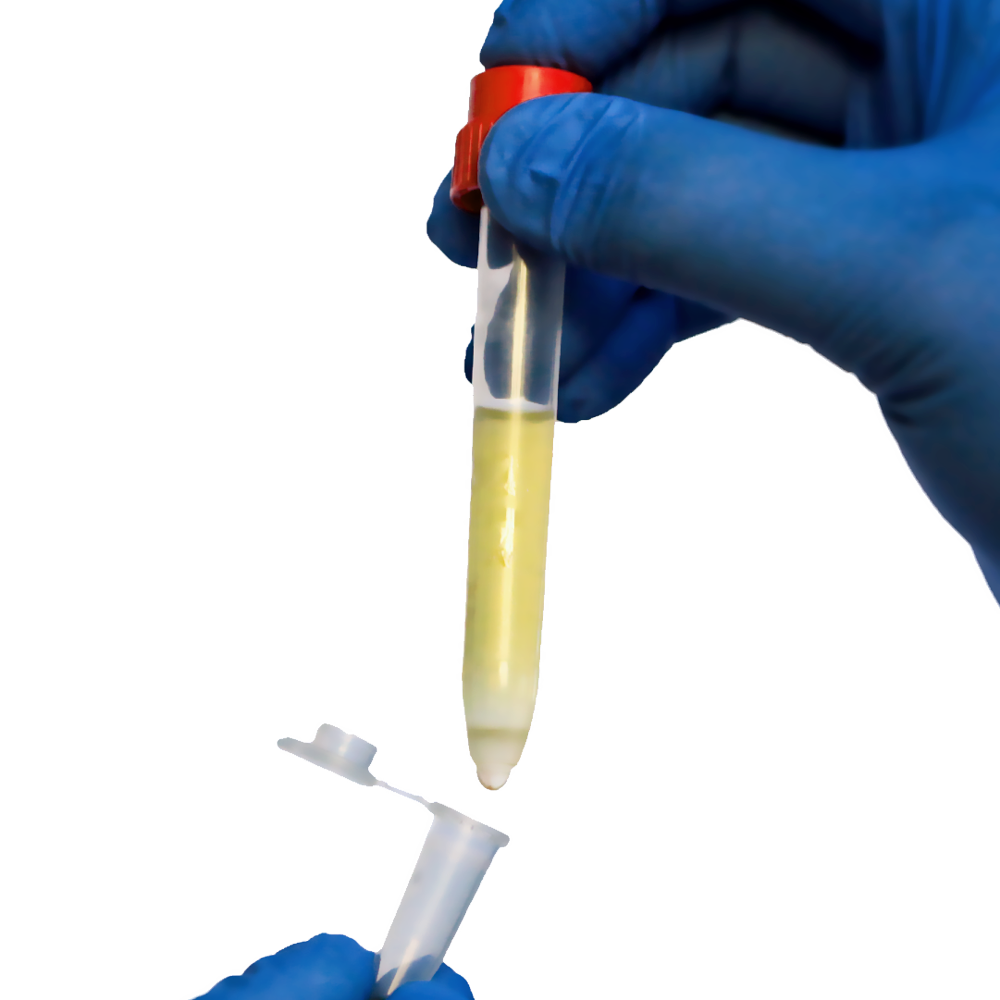
At the core of pluriSpin’s advantage is its one-step negative isolation strategy. Instead of directly labeling or capturing target cells, pluriSpin binds unwanted cells during a brief incubation. This step requires minimal hands-on time and does not depend on precise timing or specialized equipment. After incubation, the sample is processed using standard density gradient centrifugation, a familiar and widely used technique in most laboratories. During centrifugation, labeled unwanted cells pellet, while the desired, untouched cells remain enriched at the interface between plasma and the density gradient medium.
This design eliminates several steps that traditionally slow down HTS workflows. There are no columns to equilibrate, no magnetic racks to manage, and no repeated wash cycles that must be synchronized across multiple samples. Because collection happens directly from a clearly defined interface, operators can move quickly and confidently from centrifugation to downstream assays.
Another key benefit is compatibility with existing infrastructure. pluriSpin does not require new instruments or workflow redesigns, making it easy to integrate into established screening pipelines. Its standardized steps also support automation or semi-automation, helping laboratories maintain uniform processing across plates, batches, and operators. By reducing isolation to a predictable, repeatable process, pluriSpin transforms cell preparation from a limiting factor into a reliable foundation for high-throughput screening.
Where pluriSpin Fits in the HTS Pipeline
In high-throughput screening workflows, timing and placement of cell isolation are just as important as the isolation method itself. pluriSpin is designed to fit naturally into the early preparation stage of the HTS pipeline, where cell quality has the greatest impact on downstream assay performance.
Typically, pluriSpin is used immediately after sample receipt or thawing, before cells are exposed to stimulation, labeling, or compound libraries. By removing unwanted cells, such as platelets or lineage-negative populations, at this early stage, pluriSpin ensures that the starting cell population entering the screening assay is clean, consistent, and functionally intact.
In immune screening workflows, pluriSpin is often applied before:
- Cytotoxicity assays
- Immune activation or suppression studies
- Co-culture experiments
- Compound screening involving PBMCs, T cells, NK cells, or monocytes
Because the isolated cells remain untouched and unlabeled, they can be directly transferred into assay plates without additional washing or recovery steps. This reduces delays between isolation and screening, which is critical in HTS environments where cell stress or time-dependent activation can distort results.
pluriSpin also integrates smoothly into workflows that involve parallel processing of multiple donors or conditions. Since the protocol relies on standardized incubation and centrifugation steps, isolation can be synchronized across batches, supporting consistent assay timing and improved comparability.
By positioning pluriSpin as the final preparation step before screening begins, laboratories can stabilize input cell quality, reduce variability, and improve the reliability of high-throughput readouts.
HTS Cell Types That Benefit Most from pluriSpin
High-throughput screening workflows often involve cell types that are highly sensitive to handling, activation, or contamination. pluriSpin is particularly well suited for these applications because it isolates cells through negative selection, leaving target populations untouched and functionally intact.
Peripheral Blood Mononuclear Cells (PBMCs)
PBMCs are widely used in immune profiling, drug screening, and functional assays. pluriSpin enables clean PBMC isolation directly from whole blood or buffy coat while reducing platelet contamination. This results in more stable baseline responses and improved assay reproducibility across screening plates.
T Cells
Both total T cells and defined subsets are common in HTS-based immune activation and cytotoxicity assays. Because pluriSpin does not bind antibodies or beads to target cells, T-cell receptors remain accessible and unaltered, supporting reliable stimulation and signaling readouts.
Natural Killer (NK) Cells
NK cells are highly sensitive to mechanical stress and surface modification. pluriSpin preserves their cytotoxic potential by minimizing manipulation and avoiding activating interactions during isolation, making it well suited for HTS cytotoxicity and compound response assays.
Monocytes
Monocytes are prone to activation during harsh isolation procedures. pluriSpin allows monocyte enrichment without forcing cells through columns or exposing them to magnetic fields, supporting consistent behavior in inflammation and differentiation-based screens.
Rare or Low-Abundance Populations
In HTS workflows targeting rare cells, even small losses can affect data quality. pluriSpin’s gentle, one-step workflow improves recovery and consistency, making it easier to generate reliable data from limited or valuable samples.
By maintaining cell viability, surface integrity, and functional responsiveness, pluriSpin supports a broad range of HTS-relevant cell types without compromising downstream assay performance.
Preserving Cell Functionality for Reliable Screening Results
In high-throughput screening, speed alone is not enough. The reliability of screening data depends on the biological integrity of the cells used in each assay. Even subtle damage introduced during cell isolation can change signaling behavior, alter responsiveness to compounds, or increase background noise in readouts. When hundreds or thousands of conditions are tested in parallel, these effects multiply and can lead to false positives, false negatives, or poor reproducibility.
pluriSpin addresses this challenge by keeping target cells untouched throughout the isolation process. Because it uses negative cell isolation, only unwanted cells are labeled and removed. The cells of interest never come into contact with antibodies, magnetic beads, or columns. As a result, surface receptors remain unblocked, membrane integrity is preserved, and natural cell–cell signaling pathways remain intact. This is especially important for assays that depend on receptor engagement, ligand binding, or immune activation, where even minor interference can distort results.
The physical handling of cells is also significantly reduced. pluriSpin avoids harsh mechanical steps such as forcing cells through filters or columns. There are no repeated wash cycles that expose cells to prolonged buffer changes, and no additional centrifugation steps beyond standard density gradient separation. This gentle handling reduces shear stress and limits the risk of triggering stress responses, apoptosis, or unintended activation.
Because cells remain viable and functionally intact, they can be used immediately after isolation. pluriSpin-isolated cells perform consistently in cytotoxicity assays, immune profiling, compound screening, and stimulation studies. For HTS workflows, where decisions are often based on small differences in response across large datasets, preserving true biological behavior is essential. pluriSpin ensures that screening outcomes reflect compound effects rather than artifacts of sample preparation, supporting more confident data interpretation and downstream development.
Scaling pluriSpin for High-Volume and Multi-Donor Screening
High-throughput screening environments are defined by scale. Dozens or even hundreds of samples may need to be processed in a single day, often sourced from different donors and collected under varying conditions. In these settings, any isolation method that becomes more complex as volume increases quickly turns into a bottleneck. pluriSpin was designed to avoid this problem by keeping the workflow simple and uniform, regardless of scale.
Because pluriSpin relies on a fixed incubation step followed by standard density gradient centrifugation, the protocol remains the same whether processing a handful of samples or an entire screening batch. There are no additional setup steps, equipment adjustments, or calibration requirements as sample numbers increase. This allows laboratories to run many samples side by side under identical conditions, which is essential for reducing batch effects and ensuring data comparability.
Multi-donor screening studies benefit particularly from this consistency. When comparing immune responses, cytotoxicity, or compound sensitivity across donors, differences in cell isolation can mask or exaggerate biological variation. pluriSpin minimizes this risk by standardizing preparation across all samples, making observed differences more likely to reflect true donor-specific biology rather than technical noise.
The system also adapts well to different input materials. Whole blood, buffy coat, and cord blood can all be processed using the same core workflow. Even samples that are older or have higher platelet content can be handled effectively, helping screening programs remain flexible when ideal sample timing is not possible.
By combining scalability with low hands-on time and gentle processing, pluriSpin allows HTS laboratories to expand throughput confidently. It supports large studies without sacrificing cell quality, reproducibility, or operational efficiency, making it well suited for demanding, high-volume screening workflows.
Conclusion
High-throughput screening places unique demands on cell isolation workflows. Speed alone is not enough, HTS environments require methods that deliver consistent cell quality across large sample numbers while minimizing variability, handling time, and operator dependence. Traditional isolation approaches that rely on multiple wash steps, specialized equipment, or force-based manipulation often struggle under these conditions, introducing stress to cells and inconsistency between runs.
pluriSpin addresses these challenges through a negative isolation strategy that is both practical and robust. By labeling and removing unwanted cells while leaving target populations untouched, it preserves native cell function, surface markers, and viability, qualities that are critical for reliable screening readouts. The streamlined workflow, based on a short incubation followed by standard density gradient centrifugation, reduces hands-on time and removes unnecessary complexity from sample preparation.
Equally important, pluriSpin scales naturally. Whether processing a small pilot study or a large multi-donor screening campaign, the protocol remains unchanged. This consistency supports reproducibility across batches and operators, helping laboratories generate data that can be confidently compared and interpreted. Compatibility with whole blood, buffy coat, and cord blood further enhances flexibility in real-world screening programs.
For HTS laboratories focused on efficiency, data quality, and biological relevance, pluriSpin offers more than convenience. It aligns cell isolation with the practical realities of high-throughput work, allowing researchers to focus on assay performance and discovery rather than troubleshooting preparation steps. In doing so, pluriSpin becomes a reliable foundation for meaningful, scalable screening workflows.
 English
 French
 German
 Spanish
 Belgium
 Italian
 Brazil
 Chinese Mandarin