Peripheral blood mononuclear cells (PBMCs) play an important role in many areas of biological and medical research. They are widely used in immunology, flow cytometry, cell culture, molecular analysis, and functional assays. Because these applications depend heavily on sample quality, PBMC isolation must be both efficient and reliable.
Traditional PBMC isolation methods have been used for many years, but they often involve slow and labor-intensive workflows. Manual overlaying of blood onto density gradient media requires careful handling, precise pipetting, and constant attention to avoid disturbing the separation layers. When processing multiple samples, these steps become time-consuming and increase the risk of inconsistency between experiments.
Modern laboratories now require workflows that are faster, easier to standardize, and less dependent on operator technique. At the same time, speed cannot come at the cost of sample purity or cell recovery. pluriMate® was designed to address this challenge. By simplifying density gradient separation and removing the need for manual overlaying, pluriMate® helps laboratories isolate PBMCs more efficiently while maintaining high-quality separation conditions.
This article explores how pluriMate® supports faster PBMC isolation workflows without compromising purity, recovery, or reproducibility.
Understanding PBMC Isolation Workflows
PBMCs include several important immune cell populations, such as:
- Lymphocytes
- Monocytes
- Natural killer cells
These cells are commonly isolated from:
- Whole blood
- Bone marrow
- Other anticoagulated biological samples
PBMC isolation is often the starting point for many downstream workflows, including:
- Flow cytometry
- Immune profiling
- Cell culture
- Cytokine analysis
- Functional assays
- Molecular studies
Because downstream applications depend on the quality of the isolated cells, the separation process must maintain:
- High cell viability
- Good purity
- Consistent recovery
Any disturbance during isolation can affect the reliability of later experiments.
Why Traditional PBMC Isolation Methods Are Time-Consuming
Traditional density gradient separation methods typically involve careful manual layering of blood onto a density gradient medium. Although widely used, this process introduces several workflow limitations.
Manual Overlaying of Blood
In standard protocols, blood must be slowly layered onto the density gradient medium without mixing the layers.
This requires:
- Careful pipetting
- Steady hands
- Consistent technique
Even small mistakes can disturb the separation environment.
Risk of Mixing During Layering
If the blood is added too quickly or at the wrong angle:
- The sample may mix with the density medium
- The gradient may become unstable
- PBMC separation quality may decrease
This often leads to poorly defined interphases after centrifugation.
Multiple Handling Steps
Traditional workflows frequently involve:
- Sample dilution
- Manual overlaying
- Layer adjustment
- Careful aspiration during collection
Each step adds processing time and increases handling complexity.
High Dependence on Operator Skill
Successful overlaying depends heavily on experience and technique.
As a result:
- Different operators may produce different outcomes
- Reproducibility becomes difficult
- Workflow consistency decreases
Increased Processing Time for Multiple Samples
When laboratories process multiple blood samples simultaneously, manual overlaying becomes a major bottleneck.
Careful layering must be repeated for every sample, increasing:
- Hands-on time
- Workflow delays
- Operator fatigue
Common Quality Problems in PBMC Isolation
Speed is not the only challenge in PBMC isolation. Poor handling during separation can reduce overall sample quality.
Disturbed Density Gradients
Disturbance during layering can blur the separation boundary between blood and density medium.
This affects:
- Cell migration during centrifugation
- Layer stability
- Interphase formation
Poor Interphase Formation
An unclear interphase makes PBMC collection more difficult.
This increases the risk of:
- Collecting unwanted cells
- Losing target cells
- Reducing overall purity
Contamination with Erythrocytes and Granulocytes
Improper separation may allow unwanted cells to enter the PBMC fraction. This reduces sample quality for downstream applications.
Platelet Contamination
Platelets often remain in the plasma and may contaminate the PBMC layer.
Platelet contamination can:
- Affect flow cytometry
- Alter cell culture conditions
- Reduce assay consistency
Loss of Target Cells During Collection
Disturbed layers make it harder to collect PBMCs accurately.
This can reduce:
- Cell yield
- Recovery efficiency
- Reproducibility
Variability Between Samples
Manual workflows introduce inconsistencies between operators and experiments. This variability becomes especially problematic in high-throughput research environments.
Introducing pluriMate®
pluriMate® was developed to simplify PBMC and leukocyte isolation workflows while improving separation consistency. Traditional density gradient separation methods often depend on careful manual overlaying, which can be slow, technique-sensitive, and difficult to standardize across multiple samples. pluriMate® addresses these limitations through a more structured and user-friendly design.
Its key feature is a porous polyurethane sponge barrier placed inside the centrifuge tube. This sponge acts as a physical separation layer between the sample material and the density gradient medium before centrifugation begins.
This barrier performs several important functions:
- Separates the sample from the density gradient medium before centrifugation
The sponge keeps the blood or bone marrow sample positioned above the density medium without requiring delicate manual layering. This helps preserve the integrity of the separation environment from the very beginning of the workflow.
- Eliminates the need for manual overlaying
Instead of slowly pipetting blood onto the density gradient medium, users can directly add the sample into the tube. This removes one of the most time-consuming and technique-dependent steps in PBMC isolation.
- Maintains stable separation conditions
By preventing premature mixing between the sample and density medium, the sponge supports more consistent gradient formation during centrifugation.
Instead of carefully layering blood onto the density medium, users can simply pour anticoagulated whole blood or bone marrow directly from the collection tube into the pluriMate® tube. This significantly simplifies sample preparation while reducing handling time and contamination risk.
During centrifugation, leukocytes, lymphocytes, and PBMCs separate efficiently from erythrocytes and granulocytes according to the selected density gradient medium. The resulting interphase remains well-defined and easier to harvest after centrifugation.
The sponge barrier also helps reduce remixing during collection, supporting cleaner recovery of the enriched cell fraction. Together, these features transform PBMC isolation into a faster, more controlled, and more reproducible workflow for modern laboratories.
How pluriMate® Speeds Up PBMC Isolation
No Manual Overlaying Required
One of the biggest advantages of pluriMate® is the elimination of manual layering.
Users no longer need to:
- Slowly pipette blood over the density medium
- Adjust layering angles carefully
- Worry about disturbing the gradient during setup
This immediately reduces preparation time.
Direct Sample Loading
Samples can be added directly from the blood collection tube into the pluriMate® tube. This simplifies workflow setup and reduces handling complexity.
Direct loading also minimizes:
- Pipetting steps
- Transfer-related errors
- Exposure to contamination
Faster Workflow Setup
Because overlaying is eliminated, sample preparation becomes much faster.
This is especially beneficial when processing:
- Multiple patient samples
- High-throughput studies
- Time-sensitive experiments
Reduced Hands-On Time
pluriMate® reduces manual intervention during preparation. Researchers spend less time performing delicate pipetting steps and more time focusing on downstream analysis.
Brake-On Centrifugation Compatibility
Traditional density gradient workflows often require centrifugation without braking to avoid disturbing the layers. pluriMate® supports centrifugation with the brake on. This simplifies workflow management and shortens overall processing time.
Simplified Cell Collection
After centrifugation:
- Plasma is removed
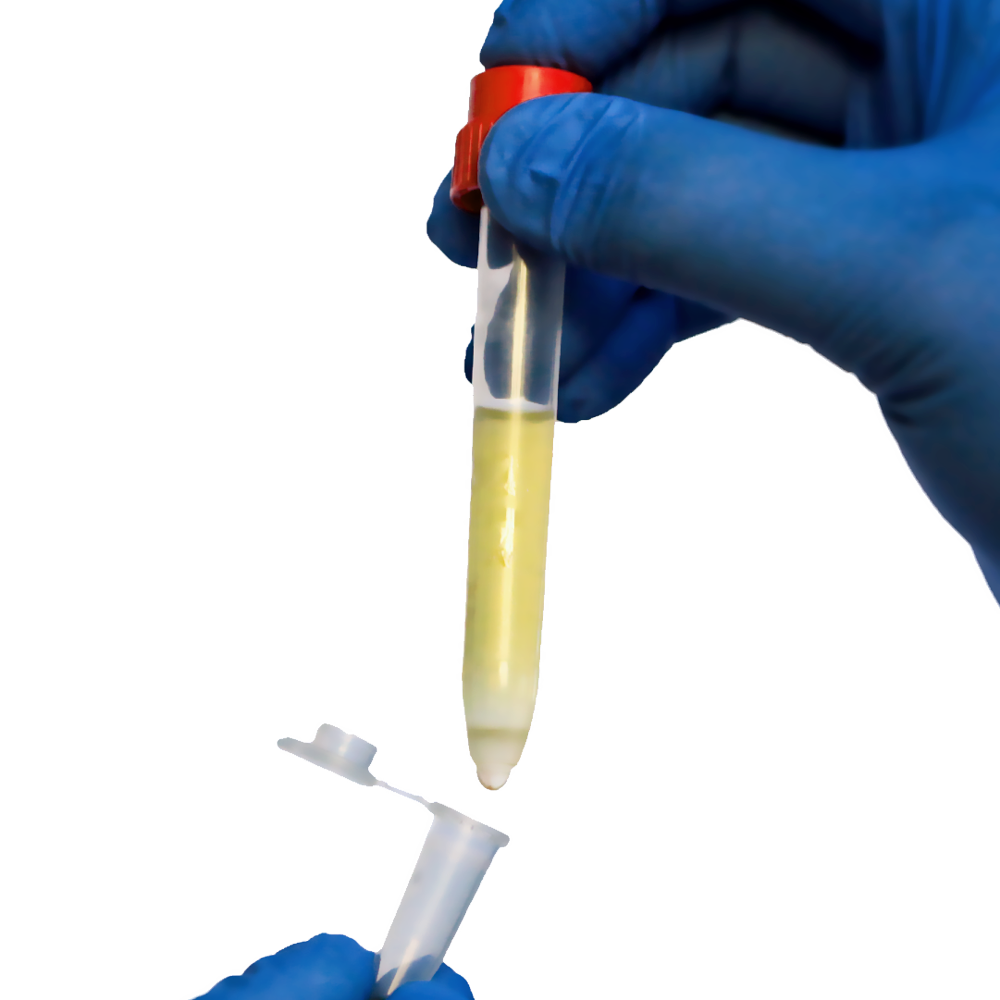
- The PBMC layer is collected directly into a fresh tube
The sponge barrier helps preserve layer separation during harvesting. This makes collection easier and more consistent.
How pluriMate® Maintains Sample Quality
Faster workflows are valuable only if sample quality remains high. pluriMate® improves quality by stabilizing the separation environment.
Stable Separation Environment
The porous barrier keeps the blood sample and density medium separated before centrifugation begins. This prevents premature mixing and supports more controlled separation.
Prevention of Premature Mixing
Unlike manual overlaying, where layering errors are common, pluriMate® provides built-in physical separation. This reduces operator-dependent variability.
Cleaner Interphase Formation
Stable gradient conditions support the formation of a clearer PBMC interphase.
This improves:
- Visibility during collection
- Purity of isolated cells
- Recovery consistency
Reduced Recontamination During Harvest
After centrifugation, the barrier helps prevent unwanted cells from remixing into the PBMC fraction during collection. This supports cleaner isolation results.
Better Consistency Across Samples
Because the workflow is less dependent on manual technique, laboratories achieve more reproducible results across different users and experiments.
Minimizing Platelet and Unwanted Cell Contamination
Platelet contamination is a common challenge in PBMC isolation workflows.
Platelets can:
- Bind to leukocytes
- Interfere with flow cytometry
- Affect cell culture conditions
- Introduce assay variability
pluriMate® workflows can be combined with pluriSpin® PLT Depletion to help reduce platelet contamination before separation.
This improves:
- PBMC purity
- Downstream assay consistency
- Sample quality in older blood samples
Reducing unwanted cell contamination is especially important for sensitive downstream applications.
Supporting Both Small- and Large-Volume Workflows
pluriMate® is available in multiple tube formats to support different workflow requirements.
Flexible Tube Formats
Available tube sizes support:
- Small-volume workflows
- Medium-scale processing
- Larger sample preparation
Compatibility with Different Sample Volumes
The system can process:
- 0.25–1 mL samples
- 2–11 mL samples
- 5–30 mL samples
This flexibility makes pluriMate® adaptable across many laboratory settings.
Adaptability Across Laboratory Workflows
pluriMate® integrates easily into:
- Research laboratories
- Clinical workflows
- High-throughput sample processing environments
Applications Where pluriMate® Performs Best
pluriMate® supports a wide range of laboratory workflows involving PBMC and leukocyte separation. Its simplified handling and stable separation conditions make it useful across both routine and research-focused applications.
PBMC Isolation from Whole Blood
pluriMate® is highly effective for isolating peripheral blood mononuclear cells directly from anticoagulated whole blood samples. The sponge barrier simplifies the separation setup and helps maintain cleaner density gradient conditions during centrifugation.
This supports:
- Efficient recovery of PBMCs
- Reduced contamination from erythrocytes and granulocytes
- More consistent interphase formation
- Faster processing of multiple blood samples
The simplified workflow is especially valuable in laboratories handling large sample numbers or time-sensitive studies.
Bone Marrow Cell Separation
Bone marrow samples are often more complex than standard blood samples because they contain higher cell densities and more heterogeneous material. pluriMate® helps manage this complexity by maintaining stable separation conditions throughout centrifugation.
The system supports:
- Reliable leukocyte separation
- Efficient PBMC enrichment from bone marrow material
- Cleaner recovery of target cell populations
- Reduced disturbance during harvesting
This makes it useful for both research and specialized cell preparation workflows.
Immunology Research
Many immunology studies require highly viable and reproducible immune cell populations. pluriMate® supports these applications by improving the consistency of PBMC isolation.
Researchers can obtain cleaner immune cell fractions for:
- Immune profiling
- Cytokine studies
- Cell activation experiments
- Functional immune assays
Reducing unwanted contamination helps improve the reliability of downstream experimental results.
Flow Cytometry Preparation
Sample quality is critical for accurate flow cytometry analysis. Cell aggregates, platelet contamination, and unwanted debris can interfere with measurements and reduce data quality.
pluriMate® helps improve sample preparation by supporting:
- Cleaner PBMC isolation
- Better removal of unwanted cells
- More defined cell populations
- Improved reproducibility between samples
This creates more stable starting material for downstream cytometric analysis.
Cell Culture and Functional Assays
Cell culture workflows depend heavily on the quality and viability of isolated PBMC populations. Excessive handling or poor separation can negatively affect cell behavior in culture.
pluriMate® supports these workflows by:
- Reducing handling-related stress
- Supporting cleaner isolation conditions
- Improving consistency between preparations
- Preserving viable PBMC populations
This makes the system useful for cultivation studies, stimulation assays, and other functional applications.
Negative Cell Separation Workflows
pluriMate® can also be combined with pluriSpin® workflows for negative isolation applications. In these workflows, unwanted cells are labeled and removed while the target population remains untouched.
The combination supports:
- Cleaner enrichment workflows
- Reduced manual handling
- More efficient downstream isolation
- Improved purity of untouched target cells
This integration makes pluriMate® adaptable for laboratories performing advanced cell separation and enrichment workflows.
Conclusion
Traditional PBMC isolation workflows often require careful manual overlaying, extensive handling, and highly controlled centrifugation conditions. These steps can slow down processing, increase variability, and introduce contamination risks.
pluriMate® simplifies this process through its integrated porous barrier system, which eliminates the need for manual layering while maintaining stable density gradient separation conditions. By supporting direct sample loading, brake-on centrifugation, and simplified harvesting, it helps laboratories process samples faster without compromising PBMC quality. At the same time, pluriMate® improves consistency by reducing operator-dependent variation and minimizing recontamination during collection.
As laboratories continue moving toward faster and more scalable workflows, smarter separation systems like pluriMate® are becoming increasingly valuable for efficient and reproducible PBMC isolation.
 English
 French
 German
 Spanish
 Belgium
 Italian
 Brazil
 Chinese Mandarin