Many research applications require the study of immune cell populations without interference from B cells. Whether researchers are investigating T cells, NK cells, monocytes, or broader peripheral blood mononuclear cell (PBMC) populations, the presence of B cells can influence experimental outcomes and complicate downstream analysis.
Obtaining a B cell-free population is often an important first step in immunology, cell biology, and translational research. However, achieving this goal efficiently while preserving the quality of the remaining cells can be challenging. Traditional isolation methods may involve multiple processing steps, specialized equipment, or extensive manipulation that can increase workflow complexity.
pluriSpin® Human CD19⁺ Cell Depletion was developed to address these challenges through a negative isolation approach. Instead of isolating the desired cells directly, the technology removes CD19⁺ B cells from the sample while leaving the remaining cell populations untouched. The result is a highly enriched non-B cell fraction that is suitable for a wide range of downstream applications.
This article explores how pluriSpin® Human CD19⁺ Cell Depletion works and how it helps researchers obtain cleaner non-B cell populations through a practical and efficient workflow.
Why Researchers Often Need B Cell-Free Populations
Blood contains a complex mixture of immune cells, each with distinct biological functions. While B cells play important roles in antibody production and immune regulation, they are not always the focus of a particular study.
Researchers frequently require B cell depletion when working with:
- T cell studies
- NK cell research
- Monocyte-focused investigations
- Functional immune assays
- Cell signaling studies
- Cytokine analysis
- PBMC-based experiments
In these applications, reducing B cell content helps create a cleaner cellular environment for analysis. Removing unwanted B cells allows researchers to focus more directly on the populations of interest and reduces the likelihood of unwanted cellular interactions influencing experimental results.
The ability to generate a highly enriched non-B cell population can therefore improve both experimental precision and workflow efficiency.
Challenges of Traditional Non-B Cell Isolation Methods
Creating B cell-free populations is not always straightforward. Many traditional approaches introduce challenges that can affect both laboratory productivity and sample quality.
Multiple Isolation Steps
Some workflows require several rounds of separation, washing, and enrichment before acceptable depletion levels are achieved. Each additional step increases processing time and handling requirements.
Cell Loss During Processing
Every transfer, centrifugation step, and wash procedure creates opportunities for cell loss. This can become particularly problematic when working with limited sample volumes or rare cell populations.
Increased Workflow Complexity
Certain isolation methods require specialized equipment, dedicated reagents, or extensive operator training. These requirements can make routine implementation more difficult.
Potential Effects on Target Cells
Directly labeling or manipulating the desired cell population may influence downstream applications. Researchers often prefer workflows that leave the cells of interest untouched whenever possible.
Variability Between Operators
Complex protocols can produce differences in outcomes depending on handling techniques and operator experience.
These challenges highlight the value of simple and reproducible negative isolation strategies.
Understanding pluriSpin® Human CD19⁺ Cell Depletion
pluriSpin® Human CD19⁺ Cell Depletion is designed to isolate pure, viable, and untouched B cell-free populations from whole blood, buffy coat, cord blood, and similar sample materials through a negative cell isolation approach. Rather than selecting the desired cells directly, the technology focuses on removing unwanted CD19⁺ B cells from the sample, allowing the remaining cell populations to be collected in an enriched form.
The principle is straightforward. The pluriSpin® suspension selectively labels CD19⁺ B cells during a short incubation step. Once labeled, these unwanted cells are separated from the desired non-B cell populations through density gradient centrifugation. During centrifugation, the labeled B cells migrate away from the enriched fraction and pellet together with red blood cells and other unwanted components. As a result, the desired cells remain concentrated at the interface between the plasma and density gradient medium, where they can be easily collected for further use.
Several characteristics distinguish the pluriSpin® approach:
- Negative isolation strategy
- Untouched target cells
- Compatibility with whole blood, buffy coat, and cord blood
- No columns required
- No magnetic separation systems
- No specialized instrumentation
- Straightforward workflow implementation
Because the cells of interest are never directly labeled or captured, researchers obtain highly viable populations that maintain their natural characteristics. This makes the enriched cells particularly suitable for downstream applications such as flow cytometry, cell culture, functional immune studies, molecular analysis, and other research workflows where cell integrity is important.
How pluriSpin® Human CD19⁺ Cell Depletion Works
The pluriSpin® workflow combines selective labeling with density gradient centrifugation to remove unwanted B cells efficiently.
Step 1: Labeling the Unwanted Cells
The pluriSpin® suspension is added directly to the blood sample. The suspension selectively binds the CD19⁺ B cells that need to be removed from the final population.
During incubation, the unwanted cells become associated with the pluriSpin® particles while the remaining cell populations remain unchanged.
Step 2: Controlled Incubation
The sample is incubated under gentle mixing conditions. This step promotes efficient interaction between the depletion reagent and the target B cells.
Because mixing occurs in suspension, labeling takes place throughout the sample volume rather than only within a specific region.
Step 3: Density Gradient Separation
After incubation, the sample is diluted and layered onto a density gradient medium.
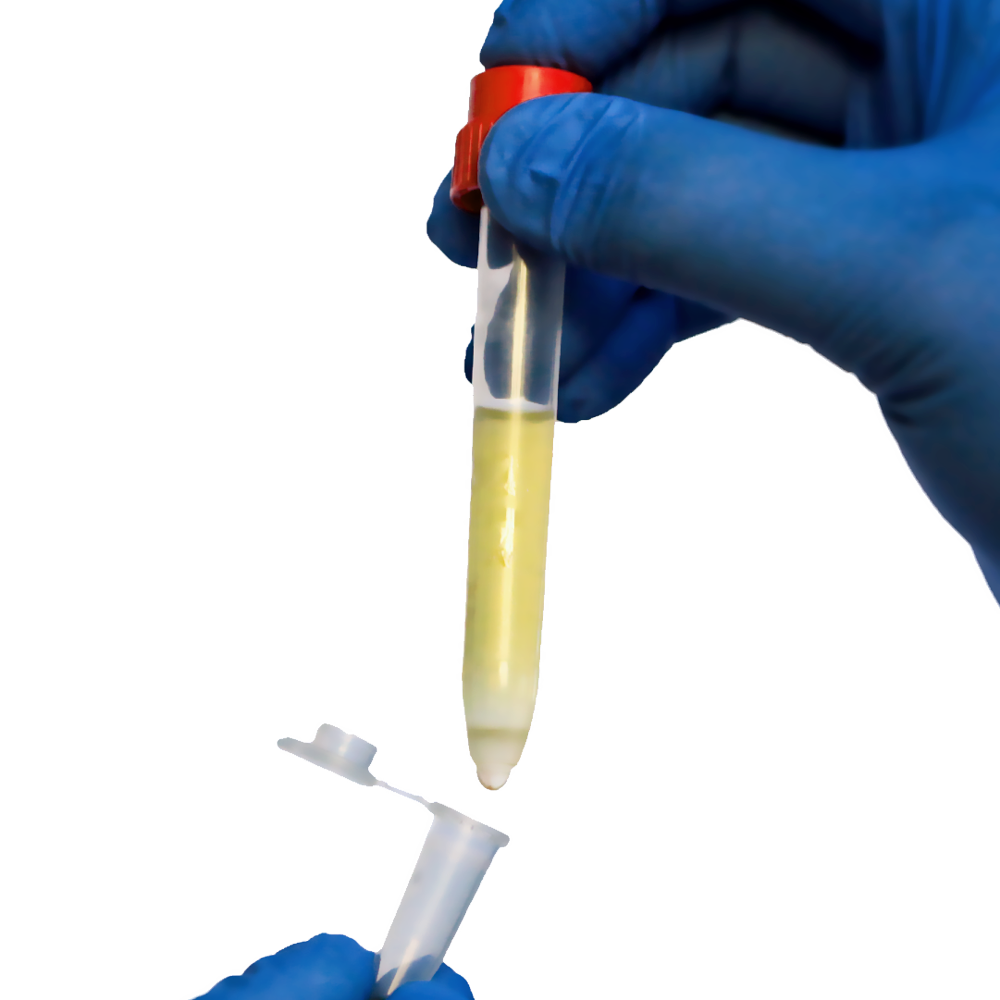
During centrifugation, the labeled B cells migrate away from the desired cell population and pellet together with red blood cells and other unwanted material. The non-B cell fraction remains enriched at the plasma-density medium interface.
Step 4: Collection of Enriched Cells
Following centrifugation, the enriched cell fraction is carefully collected from the interface.
This fraction contains the desired B cell-depleted population while the unwanted labeled cells remain separated from the collection zone.
Step 5: Washing and Recovery
The enriched cells undergo washing procedures to remove residual contaminants and improve overall sample quality. After the final wash, the cells can be resuspended at the desired concentration and prepared for downstream applications.
The workflow uses techniques that are already familiar to laboratories experienced with density gradient centrifugation, making implementation relatively straightforward.
How CD19⁺ Cell Depletion Improves Non-B Cell Purity
The primary objective of CD19⁺ cell depletion is to reduce the presence of B cells within the final sample. This improvement in purity offers several practical benefits.
Cleaner Cell Populations
By removing a significant proportion of B cells, researchers obtain populations that more accurately represent the non-B cell compartment. This allows clearer interpretation of experimental data.
Reduced Background Signals
B cells contribute their own surface markers, cytokines, and biological responses. Their removal can reduce background signals that might otherwise complicate downstream analysis.
Improved Study of Specific Cell Types
When the research focus involves T cells, NK cells, or monocytes, reducing B cell content helps improve the relative representation of those populations.
Better Experimental Consistency
More consistent cell composition supports improved reproducibility between experiments and across sample sets.
Rather than repeatedly compensating for unwanted B cell contributions, researchers can begin with a cleaner starting population.
Benefits of Negative Cell Isolation for Research Applications
Negative isolation offers several advantages that distinguish it from direct positive selection approaches. By removing unwanted cells rather than targeting the desired population, researchers can obtain cleaner samples while preserving the natural characteristics of the cells they intend to study.
Untouched Desired Cells
One of the most important benefits of negative isolation is that the cells of interest are not directly labeled, captured, or manipulated during the separation process. Instead, unwanted cell populations are selectively removed while the desired cells remain in their native state. This helps preserve cellular properties that may be important for downstream experiments and reduces concerns about potential effects caused by direct cell labeling.
Broad Application Compatibility
Untouched cell populations are useful across multiple experimental platforms, including:
- Flow cytometry
- Cell culture
- Functional assays
- Molecular analysis
- Immune response studies
Preservation of Cell Viability
Maintaining cell viability is often a major concern in cell separation workflows. Since the desired cells are not directly bound to separation reagents, negative isolation can help preserve both viability and functionality. This is particularly valuable for studies that require living cells for culture, stimulation experiments, or functional testing.
Simplified Workflow Integration
The pluriSpin® depletion workflow integrates easily into existing density gradient centrifugation protocols. Laboratories already familiar with density-based separation methods can adopt the approach without significant changes to equipment, workflow design, or staff training requirements.
Cost-Effective Cell Separation
The system provides an affordable method for generating enriched cell populations without the need for columns, magnets, or specialized separation instruments. This reduces equipment requirements while still delivering effective cell depletion and enrichment results.
Together, these advantages make negative cell isolation an attractive strategy for researchers seeking high-quality, untouched cell populations for immunology, cell biology, and translational research applications.
Sample Preparation Tips for Optimal Results
Although the pluriSpin® workflow is straightforward, proper sample handling contributes significantly to successful depletion.
Use Fresh Samples Whenever Possible
Fresh samples generally provide more predictable separation performance and improved cell quality.
Ensure Proper Reagent Resuspension
The pluriSpin® suspension should be thoroughly mixed before use to ensure uniform distribution throughout the sample.
Maintain Recommended Incubation Conditions
Proper incubation supports efficient interaction between the depletion reagent and CD19⁺ cells.
Layer Samples Carefully
During density gradient preparation, minimizing mixing between the sample and the density medium helps maintain effective separation conditions.
Perform Thorough Washing
Appropriate washing improves recovery and removes residual contaminants that may remain after centrifugation.
Consider Platelet Reduction
For applications sensitive to platelet contamination, combining the workflow with platelet depletion strategies may further improve sample quality.
Attention to these practical considerations helps maximize both purity and recovery.
Why Researchers Choose Us for Cell Separation Solutions
At pluriSelect, we focus on developing practical technologies that simplify cell separation while supporting reliable research outcomes.
Our products are used in a variety of research areas, including:
- Immunology
- Cell biology
- Diagnostics
- Translational medicine
- Basic scientific research
Researchers choose pluriSelect because we provide solutions designed around real laboratory needs.
Application-Focused Development
Our technologies are developed to address specific separation challenges rather than relying on generic approaches.
User-Friendly Workflows
We prioritize practical protocols that fit naturally into existing laboratory procedures.
Flexible Product Portfolio
Our pluriSpin® range supports multiple enrichment and depletion applications, allowing researchers to select the approach that best matches their objectives.
High-Quality Manufacturing
Products are developed and produced according to strict quality standards to support reliable performance.
Scientific Support
Our team works closely with researchers to help optimize workflows and support successful project outcomes.
As a biotechnology company focused on cell and protein separation, pluriSelect continues to develop solutions that help researchers spend less time managing workflows and more time generating meaningful data.
Conclusion
Many research applications require highly enriched non-B cell populations to support accurate analysis and reliable experimental outcomes. Traditional isolation methods can introduce complexity through multiple processing steps, specialized equipment requirements, and increased handling.
pluriSpin® Human CD19⁺ Cell Depletion offers a practical alternative through negative isolation. By selectively labeling unwanted CD19⁺ B cells and removing them during density gradient centrifugation, the technology enables researchers to obtain cleaner non-B cell populations while leaving the desired cells untouched.
The result is a streamlined workflow that supports purity, viability, and experimental flexibility. For laboratories seeking a straightforward approach to B cell depletion from whole blood, buffy coat, or cord blood, pluriSpin® Human CD19⁺ Cell Depletion provides an efficient solution that integrates easily into existing cell separation workflows.
 English
 French
 German
 Spanish
 Belgium
 Italian
 Brazil
 Chinese Mandarin